By John Silverton
On 10th March 1914 Mary Richardson, one of the most militant of the suffragettes, walked into the National Gallery in London and attacked Diego Velazquez’s famous painting, The Rokeby Venus. Wielding a meat cleaver, she slashed the canvas seven times before being restrained. Her protest was to draw attention to the issue of women’s suffrage and the imprisonment of the charismatic suffragette leader Emily Pankhurst. In a later statement she also revealed choosing a painting depicting a naked lady was a protest against the objectification of women.
Henceforth, paintings in galleries have been the unfortunate victims of antisocial individuals and nefarious protest groups, defacement with a knife often the preferred modus operandi.
Several artists, in fits of frustrated pique unhappy with their creations, are known to have destroyed their own works by slashing, including Claude Monet and Francis Bacon. But in 1957 Italian artist Lucio Fontana introduced incisions to the surface of monochrome abstract canvases, creating a three-dimensional spatial aspect to flat paintings for which Fontana achieved world-wide success. It is wrong to consider his slashed works as his best; however they are for what he is best remembered. Fontana supported the New York based “Destroy to Create” movement and maintained the slashes enabled him to escape the prison-like constraint of the smooth flat surface of a painting in both a symbolic and material sense.
However, is Fontana’s claim to be the originator of the creative slash technique true?
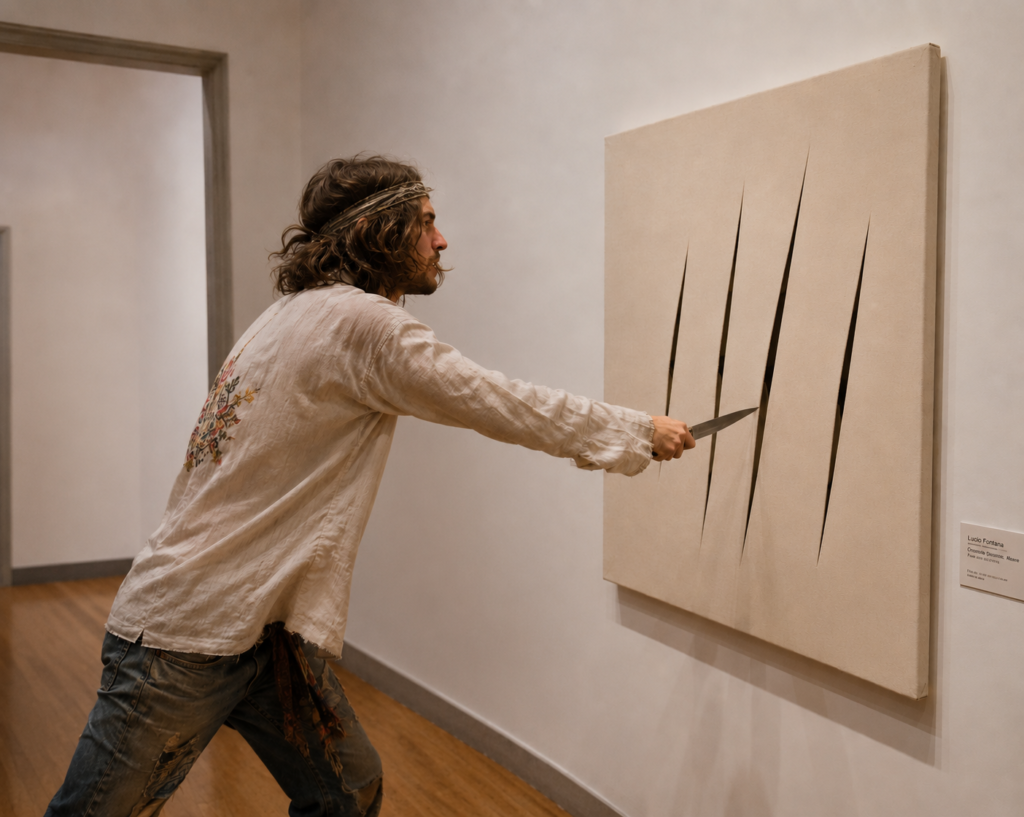
In 1956, a long haired, bearded, hippy art student, John Smith, went on trial at the Old Bailey charged with criminal damage to a work of art. Acting on behalf of the Tate Gallery, the prosecution argued the defendant did wilfully take a knife and slash his client’s painting, an act of vandalism damaging the work beyond repair.
The defence argued that far from damaging an existing artwork, his client had created a radically original work, by introducing a spatial element to an otherwise flat, mundane, monochrome canvas. Creation, not destruction, was his client’s motive.
This rationale had been hastily concocted by John as he sat on an uncomfortably hard bench shivering in a cold, dimly lit cell beneath the courts, regretting his impetuous act of vandalism against an innocently bland painting. But as the trial progressed, he began to ponder the truth of this defence; he became convinced that he had indeed introduced a revolutionary artistic concept that broke with the constraints and tradition of the past whilst heralding a liberating approach for the future.
The defence’s argument failed to impress the jury unsympathetic to developments in modern art and to unkempt bohemian art students.
‘Guilty!’ announced the foreman of the jury and the judge handed down two years at her Majesty’s pleasure.
Upon his release in 1958, John enthusiastically set to work splashing paint and slashing canvas to produce a body of work he was convinced would take the art world by storm. But he was a year too late.
Unfortunately, fate had a hand when John had wielded the knife. The abstract canvas John originally slashed had been painted by Lucio Fontana.
Author Bio:
John Silverton is the author of A Pearl Amongst Oysters, a passionate suspenseful interracial romance spanning fifty years and two continents, available in paperback from Amazon Books.
A collection of short stories will be published later this year. John is twice winner of the Anderida Writers short story competition, 2024 and 2026. A second novel, a crime thriller set in the art market, will be published in 2027.
Contact Author:
Email: johnsilverton@hotmail.co.uk