
By John Silverton
A class of infants were engaged in drawing and painting pictures and as the teacher walked around surveying their efforts one little girl, Sarah, had sketched a portrait of a man.
‘Who’s that your drawing Sarah?
‘It’s Jesus.’
‘Oh sweetheart, no one knows what Jesus looked like.’
‘They will when I’ve finished my picture.’
An old joke, I hear you groan, but nonetheless true. The Bible’s text is around three-quarters-of-a-million words, but incredibly, there is no physical description of Christ. Two vague references are contradictory: the Old Testament prophet Isaiah reads that the coming saviour will have “no beauty or majesty,” whilst the Book of Psalms claims he was “fairer than the children of men,” (“fair” referring to physical beauty). There are no contemporary or near contemporary documents relating to or describing Him or His life.
Thus we do not know if Jesus was handsome or ugly, bearded or bald, tall or short, fat or thin, happy or sad. There is no inkling from his relatives, friends, enemies, acquaintances, apostles, evangelists, chroniclers, historians or from the 5,000 he fed! His disciples do not describe his appearance. No one who knew Him, or even knew someone who knew Him, provided any form of description.
King Agbar of Edessa (Turkey) sent a painter to the Holy Land to paint Jesus. According to legend capturing Christ’s image was impossible because of the dazzling light emanating from Christ’s face.
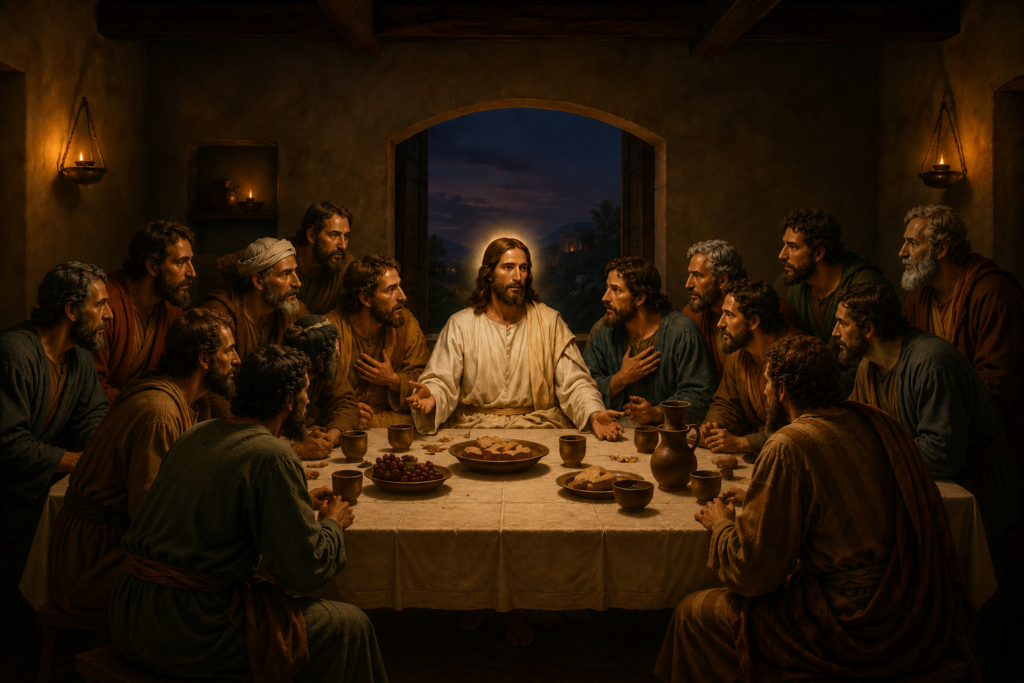
From the first painted image of Jesus, AD 1350, whenever we see Him in a painting, we recognise Him; we instinctively know what Jesus of Nazareth looked like: robed, quite tall, slim, with a benevolent expression, long brown hair and sporting a modest beard.
This is how artists down the centuries have portrayed his image without any evidential corroboration. It is art that has given Him that face.
But that face is white European, not the brown hair, brown eyes and coffee pigmentation of other Jews of first century Galilee. Artists for six centuries were European and produced images of their own creed or likeness and European missionaries perpetuated that misrepresentation.
But what about the infamous legendary image embedded into the Turin Shroud burial cloth? The five-by-one metre shroud bears a faint negative-style image of a man’s body with blood stains indicating hands nailed to a cross, whipped slashes, stabbings with a spear, and a crown of thorns corresponding to Jesus’ fate. Byzantine paintings have facial features that bear similarity to the image on the shroud. Medieval artists frequently replicated Byzantine icon images and so created the stereotypical image we recognise today.
How the shroud’s imprint was created continues to elude indisputable scientific explanation. However, in 1988 analysis of the cloth’s yarn by carbon dating techniques proved it to be around the 13th century. Legend relates that following the crucifixion His burial cloth was sent to a convent in Edessa where it remained hidden, or at least undiscovered, for a millennium. Why Edessa in Turkey and who sent it?
In the twelfth century the Shroud was allegedly pillaged by the warring Crusaders and later passed to the Knights Templar, who reputedly worshipped the portrait of a bearded man. In the fourteenth century the Templars were disbanded, imprisoned or murdered and their possessions confiscated and somehow the Shroud ended up in Turin Cathedral. The Shroud is one of many legends surrounding the death of Jesus, but that’s all it is, legend.
Author Bio:
John Silverton is the author of A Pearl Amongst Oysters, a passionate suspenseful interracial romance spanning fifty years and two continents, available in paperback from Amazon Books.
A collection of short stories will be published later this year. John is twice winner of the Anderida Writers short story competition, 2024 and 2026. A second novel, a crime thriller set in the art market, will be published in 2027.
Contact Author:
Email: johnsilverton@hotmail.co.uk