By John Silverton
In 1868 the United States Federal Government signed a treaty with the Lakota and Sioux nation that set aside the Black Hills of Dakota for the absolute and undisturbed use of the Indian people. Six years later, gold was discovered in the Black Hills and the US Government wanted the hills back to allow commercial mining. The Government offered to buy the hills and move the Native American Indians to a new reservation.
The Indians refused to cede ownership; the Black Hills were sacred territory with many burial grounds and mythical associations. The Indians felt under threat from the expanding American nation, fearing for their culture and the freedom of a nomadic way of life, so they decided to protect their land and fight against the encroachment of white American prospectors and settlers. The Lakota and Sioux warriors gathered in Montana under the great war chief Sitting Bull, and were joined by Crazy Horse and his Cheyenne to form the largest concentration of American Indian tribes in history.
General George Custer led the 7th Cavalry into the territory to enforce the removal of the Indians to another reservation. The legendary Sioux chief, Sitting Bull, united the warring tribes into a cohesive 3,000 strong army. Throughout 1876, several battles took place with Indian successes, most notably the Battle of Little Bighorn, Custer’s troop slaughtered with the loss of 274 soldiers – including Custer and his two brothers – a stunning but temporary victory. The following year the Indian Nation surrendered in the face of overwhelming force of arms, except for Sitting Bull who escaped with a band of followers to Canada, then under British control. However, four years later he was obliged to surrender and confined to a reservation in Dakota.
Because of his defeat of Custer, Sitting Bull became a legend with the American people and for a few years a star celebrity performer in the famous Buffalo Bill’s Wild West Show, before returning to the privations, endemic corruption and squalid conditions of reservation life.
In 1890, a New York Times journalist was given the task of reporting on the Indian situation. He wondered how the great Indian chief had viewed his incredible victory over Custer and how he had adapted to the White man’s way of life. The reporter travelled by train and horseback to the plains of South Dakota to interview the ageing chief.
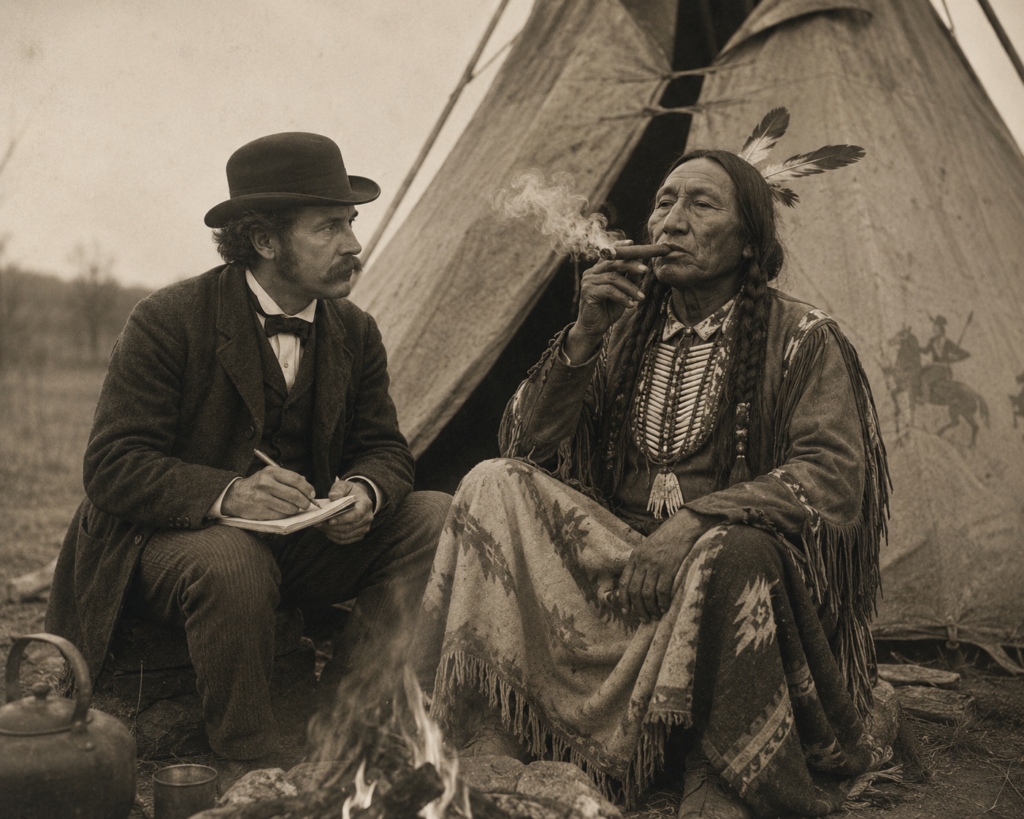
Sitting Bull was not tall but impressed with a noble austere countenance that commanded respect. Two eagle’s feathers protruded from the back of his head and his uncut hair formed into two long plaits lay across his chest. His weathered face was severely engraved by regret and disillusionment, his eyes deep set, his mouth down-turned.
Although on a reservation with basic timber-built accommodation the chief chose to live in a traditional buffalo skin tepee. The reporter reverentially greeted the old man and presented him with a box of cigars. They settled contentedly before a blazing camp fire puffing on their substitute pipes of peace. The reporter took out his notebook to record their meeting.
‘Tell me about your success at the Little Big Horn?’
‘Revenge for my people. In 1868 Custer’s Seventh Cavalry massacred families at the Sioux encampment by Washita River. The newspapers made Custer a national hero. The army’s single shot Springfield rifles no good fighting at close quarters. All Custers’ men dead in time it take hungry man to eat dinner, more braves than white men had bullets.’ He nodded with a smile of satisfaction and contentedly puffed at his cigar.
The reporter remembered Sitting Bull’s celebrated remark upon being interned on the reservation: ‘I would rather die an Indian than live a white man.’ He wanted to know if he still held this conviction.
‘You have observed the white man’s society, his industry and culture, his huge cities, his ranches and farms, his medical services and his religious convictions. Why do you prefer the nomadic life of the open plains, and not to partake in the white man’s civilized lifestyle?’
Sitting Bull drew heavily on his cigar and pondered. ‘Before white man came to the plains, Indians controlled everything. Natural foods plentiful: fish, buffalo, deer, fruits, wild corn and pure water. We moved house whenever we wanted, no mortgage and no estate agents’ fees. Everything traded or bartered, no need of money so no debt and no taxes. Medicine man free. Indian wives do all work; Indian men hunt, fish, horse ride, play and dance, visit mistresses. No religion to spoil fun.’
He paused, exhaling a heavy sigh of regret. ‘It was paradise; only the white-man dumb enough to change all that.’
Author Bio:
John Silverton is the author of A Pearl Amongst Oysters, a passionate suspenseful interracial romance spanning fifty years and two continents, available in paperback from Amazon Books.
A collection of short stories will be published later this year. John is twice winner of the Anderida Writers short story competition, 2024 and 2026. A second novel, a crime thriller set in the art market, will be published in 2027.
Contact Author:
Email: johnsilverton@hotmail.co.uk