By Mac Mckechnie
The first one landed on Tuesday. A pale, wet splat against the newly cleaned window of the Town Hall. Mrs. Tern, who handled filing and tea runs, noticed it during her lunch break and muttered something about “bloody birds” before getting back to her lukewarm soup.
By Friday, there were hundreds.
The benches outside the council offices had lost their colour beneath layers of white. The war memorial, once respectfully polished and surrounded by floral tributes, now stood coated in something that looked like salt crust from a forgotten sea. The pigeons gathered in flocks far larger than anyone remembered seeing before—on ledges, wires, rooftops. Watching.
At first, people tried to laugh it off. The local paper printed a joke article titled Coo-pocalypse Now. But humour curdled fast when the statue of Lord Winthrop, a revered local figure and former MP, was found missing its head—corroded clean away by the acidic barrage of excrement.
An accident, some said. Time and weather.
But then came the scratching.
Mr. Bell, a retired geography teacher who lived on Bethel Street, was the first to hear it. A light, rhythmic scraping at his loft hatch around 2:00 a.m. He thought it was a mouse and left out traps. The next night, the traps remained untouched, but the sound was louder. More insistent.
By the third night, he climbed the ladder himself, holding a torch and a broom, cursing under his breath. The hatch creaked open.
He was never seen again.
Only his torch was found, rolling in the middle of the hallway floor, still lit.
His house was boarded up by the end of the week.
“We’re dealing with a flocking issue,” said Councillor Hayes at the emergency town hall meeting. She adjusted her glasses, pointed to a projector slide of poo-covered cars. “Environmental health has been notified. It’s a nuisance, yes—but we’re hardly dealing with a crisis.”
She paused. “Let’s not lose perspective here.”
Mrs. Wicks, who ran the flower stall by the station, stood slowly. Her eyes were ringed with grey; her hair looked like it hadn’t been brushed in days.
“I saw one of them speak,” she said.
A snort from the back. Laughter.
“I saw it,” she repeated. “Right outside my stall. Big one, with a mangled foot. Landed on my cart. Looked me dead in the eye and said, ‘You should leave now, Margaret.’ Clear as day.”
“Margaret—” Councillor Hayes began.
“It knew my name,” she hissed.
Security escorted her out. She didn’t resist.
The next morning, every bloom in her stall had wilted black overnight.
The town changed.
People stopped going out. Umbrellas became permanent accessories, even on dry days. Children weren’t allowed to play outside. The corner café closed after a pigeon shattered the window by hurling itself, full-speed, at the glass.
Then came the bodies.
Not human. Not at first.
Cats, mostly. Sometimes dogs. Left in neat piles beneath streetlamps. Their fur matted with feathers, their eyes plucked clean. No tracks, no noise. Just sudden, surgical violence.
One brave reporter, a freelancer named Jolene Griggs, attempted an exposé. She livestreamed from her roof, voice shaking as she panned across the rooftops.
“They’re not acting like birds. I’ve watched them organise. There’s a hierarchy. They’re watching people—specific people. They don’t scatter when you run at them. They don’t fear us anymore.”
She turned the camera to herself.
“I think they’re planning something. I think—”
A shadow fell. A beat of wings. The feed cut out.
The town watched it live.
Her flat was found empty, the door still locked from the inside.
Only feathers remained.
And then it escalated.
They started entering buildings. Chimneys first. Air vents. Guttering. A whole congregation was found inside St. Agnes Church, roosting silently in the pews, eyes unblinking as the vicar walked in to find his sermon rewritten—each page replaced with a single phrase:
“We do not forgive.”
The church burned down that night. Lightning, they said. Clear skies, but lightning.
Soon, every household had its own methods. Nets. Spikes. Foil. Hawk decoys. One family in Dovetail Crescent kept an owl on retainer.
Didn’t work. Not for long.
The birds knew.
They adapted.
Mrs. Elbury, who lived above the bakery, tried poison.
The next day, her oven wouldn’t open. She had to call a locksmith. When the door finally gave way, she found it stuffed with feathers—so densely packed that they puffed out like fog, choking her as she screamed.
No one saw her again, either.
“Why here?” people whispered. “Why us?”
Some blamed the new telecoms tower. Others blamed witchcraft, or Wi-Fi, or cursed bread. One man swore the pigeons were avatars of a long-forgotten sky god. Most stopped asking altogether. Survival was quieter.
The council eventually collapsed. Councillor Hayes fled in the night with her family, leaving her resignation letter taped to the town hall door. It read only:
They want the square. Give them the square.
And so they did.
The statue of Lord Winthrop was removed. The square was sealed off, ringed with salt and garlic by desperate locals. A peace offering of seed and breadcrumbs was left in the centre, refilled each day.
And for a while, it worked.
The pigeons stayed in the square. The town lived in uneasy silence. Nobody made eye contact with them. Nobody fed them outside the border.
It wasn’t peace. But it was something.
Until Tommy Fry stole one.
He was thirteen, dared by his mates to catch one and post a video.
He did.
He filmed himself trapping a small, grey pigeon in a cardboard box behind the butcher’s. He poked it with a stick. Laughed. Called it names.
He uploaded the video.
It got twelve thousand views.
Then it got quiet.
Too quiet.
That night, the town’s lights flickered. The air filled with a low hum, like a thousand wings beating in sync.
By morning, the Fry household was gone.
Not the people—the house. Just gone.
In its place stood a single, white-covered plinth.
On top: a small, grey pigeon. Still. Watching.
No one spoke of it. Not out loud.
But they obeyed.
The square became a shrine. Offerings grew more elaborate—pastries, shiny things, old coins. Choirs hummed beneath the ledges, low and tuneless. Tourists stopped coming. No one left.
Letters came from outside authorities, but no one answered the door.
No one dared.
Eventually, the post stopped arriving altogether.
Now, years later, the town endures.
There are rules.
Never swat. Never shout. Never run.
Carry seed. Wear grey. Keep your head bowed.
The pigeons rule from the rooftops, eyes gleaming like old marbles, feathers shifting like cloaks in windless air. They do not speak anymore.
They don’t need to.
Sometimes, late at night, a new phrase appears scratched into glass or dirt or stone:
“You were warned.”
And overhead, always circling, always watching, the wings never stop.
Never.
Author Bio:
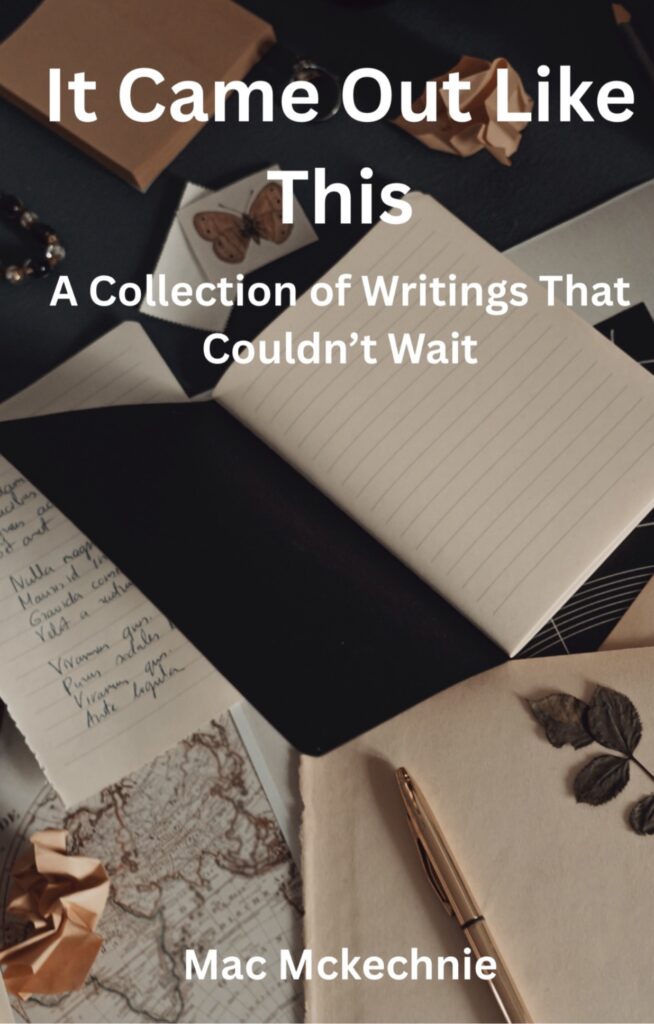
“It Came Out Like This” – Again
Stories, Poems, and Echoes of the Heart
Book 2 of the “It Came out Like This” series consists of Eighteen original short stories—some uplifting, others unsettling—are threaded together with poetic bridges that hum with nostalgia, heartbreak, and hope. Together they form a tapestry of lives lived and nearly lost, of loves remembered, choices made, and the mysterious spaces that sit between silence and sound. “The Dropping” is just one of those stories. The book is available in Paperback on Amazon.
Mac Mckechnie is a Yorkshireman and lives in Barnsley South Yorkshire. Now aged 75 he has the luxury of sufficient time on his hands to go back to his love of writing. He leads a creative writing group in Barnsley, and a lot of his ideas are sparked from work within that group.
Mac is a family man at heart, has a few hobbies, is a member of the organisation u3a, which is an organisation for older people, where he leads a group with the sport Kurling, and also the writing group. Mac is an active Christian, and the Pastor of his local church in Barnsley.
Mac has written several books, Sci-Fi being his favourite genre, but confesses that he is drawn to simple animal adventures from his younger days. This book is a simple collection of short stories and poems, owing much of its creation to stories from Bu3a creative writing groups that Mac leads. His next book in the series “It Came Out like this for the Last Time” (The third in the series) is out soon on paperback and will also be available on Amazon. Mac has just won the “Scribble” Magazine prize for short stories 2025
Contact Author:
Mac can be contacted on email: mckechnie31@btinternet.co.uk